


Who Belongs in Your Sphere of influence? Let’s take a look at who’s in it.
Grab a notebook or excel spreadsheet and jot down all the names you can think of, including:
- Past coworkers (even if your last job was waiting tables)
- Your friends (yes, even the high school pals you haven’t seen in 20 years)
- Your spouse’s or partner’s coworkers
- Your spouse’s or partner’s friends
- Your kids’ friends or their parents (depending on age)
- Your kids’ teachers and school workers
- Your extended family
- Your neighbors
- Friends and acquaintances from any social groups such as Neighborhood Association, Rotary, PTA, etc.
- Anyone you interact with regularly (even if that just means once every couple of months), for example: your hair stylist, accountant, doctor, dentist, even your bank teller.
Remember, you know the people in your SOI and how to best reach them, Call, Text, Email, etc.
Not sure what to write? Here are a couple of samples:
Sample 1:
Hello/Hey (friend, client from a former business, former boss, etc.)
Guess what? I started a new career in Real Estate! I know what you’re thinking, “great, more spam emails to follow…” but actually that’s not the case, no spam, I promise!!
To work on my home evaluating skills and to make sure I get properties sold at their optimal market value, I just need some practice. Do you mind if I use your property as a practice case study?
Can you remind me again your approximate square footage? Last time (I was over, last time we spoke, last time I ran into you at… ) you were planning on renovating the (kitchen, bathroom, finishing the basement) did you go through with the reno? Do you have any recent pictures that you can text me?
Once I finish my assessment of your property’s market value, I’ll send you the report, please let me know if I hit the mark, or missed if all together.
Thanks again!
Add your signature and contact information – including your location.
Sample 2:
Hello/Hey (friend, client from a former business, former boss, etc.)
Good news! You now have a friend in real estate – someone you can call with questions who won’t begin bombarding you with marketing messages.
As a member of the (name) Multiple Listing Service, I now have access to information about homes for sale and sold, average prices, and market trends in (name the area your MLS covers). So whether you’re curious about the selling price of a home down the street or simply wonder if prices are up or down in your neighborhood, just get in touch. I’ll be happy to do the research and get back to you quickly.
Of course, if you do happen to be in need of an agent to help you purchase or sell a home, I’d love to be that agent. And, if you have a friend or acquaintance in need of a real estate professional, I’d appreciate the referral.
You can count on me to provide up-to-date information, honest answers, dependable communication, and total support – and I promise not to be pushy.
Add your signature and contact information – including your location.
Planning your Sales Ratios
Any top sales person in any industry is fully aware of their sales ratios. Your sales ratios are your calculator of how many contacts you need to generate a sale. By knowing this information, you should be able to calculate what daily, weekly, monthly, and annual activities you need to do in order to achieve your goals.
Your sales ratios can be broken down into as many categories as you deem necessary.
For real estate, it's recommended that you track:
- Approaches - the number of individuals that you approach to discuss your services. Approaches are attempts to talk to people, even if you couldn't get a hold of the person. For example, you knocked on 100 doors today. That represents 100 approaches.
- Contacts - the number of individuals that you actually discuss your services with. If you knocked on 100 doors, and 20 people were home, that would represent 100 approaches, and 20 contacts.
- Appointments Booked - the number of appointments you book with your contacts. If you make 20 contacts, and 3 of those contacts book an appointment, that would represent 100 approaches, 20 contacts and 3 appointments booked.
- Appointments Completed - the number of appointments booked that actual follow through with the appointment. If 2 of the 3 appointments booked, complete the meeting with you, then your ratios would be 100 approaches, 20 contacts, 3 appointments booked, 2 appointment completed.
- New Clients - the number of clients that come from the appointments completed. If 1 out of the 2 clients you met with turn into a client, then your ratios would be 100 approaches, 20 contacts, 3 appointments booked, 2 appointments completed, 2 new clients.
- Sales - the number of sales you generate from your new clients. If you do 1 sale from your 2 clients, then your ratios would be 100 approaches, 20 contacts, 3 appointments booked, 2 appointments completed, 2 new clients, 1 sale.
- Revenue - the average revenue per sale. If your average revenue per sale is $5000, then your sales ratios are 100 approaches, 20 contacts, 3 appointments booked, 2 appointments completed, 1 new client, and $5000 in revenue.
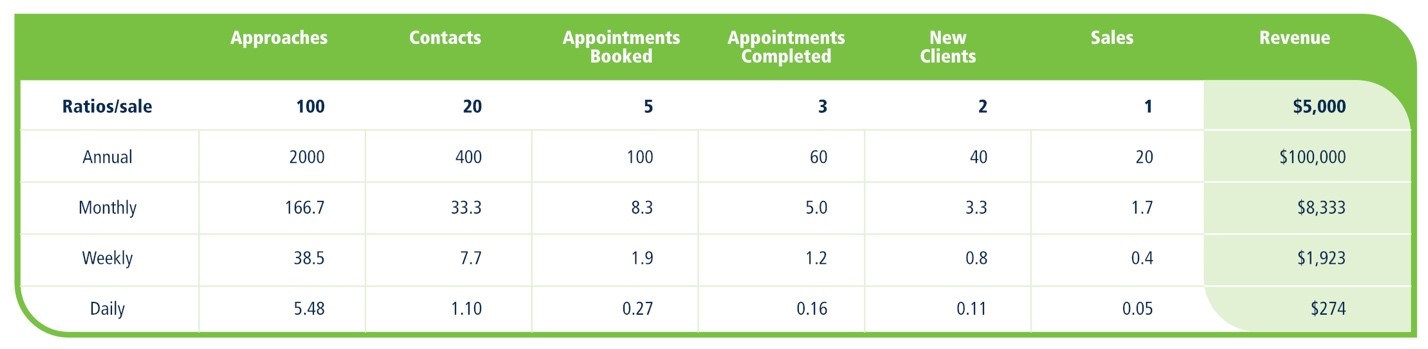
From these ratios, you can now determine the activity that you need to meet your income objectives. For example, based on these ratios, in order to earn $100,000, at an average revenue/sale of $5000, you know you will need to make 20 sales.
So, to plan your year, you know that you will need to make:
- 2000 approaches
- 400 contacts
- 100 appointments booked
- 60 appointments completed
- 40 new clients
- 20 sales
- $100,000 revenue
So, your goal is to make 5.5 approaches every day, and if you do that properly, you'll reach your income goal of $100,000.
It's so important to know your ratios. Keep track of what your actual numbers are as you progress through the year, and work out your actual sales ratios at the end of the year. With that information, you should be able to determine what part of your sales cycle you need to work on to be more productive, and to increase your sale ratio efficiency.
Examples:
- If you complete 60 appointments, but you only get 10 new clients, then perhaps you should work on your closing skills in those appointments, and work towards getting 40 - 50 clients from those 60 appointments
- If you only generate 10 sales from your 40 new clients, then you need to determine what is keeping you from generating more sales. Are you overpricing your listings? Are you not taking good enough pictures? Should your descriptions of the properties be better?
As you can see, knowing your sales ratio is crucial to being able to continually sell more with less output. Become as efficient as possible and you'll maximize your time and continually increase your revenue.
Rinse & Repeat
The key to building your Real Estate business to where you want it to be is in the Repetition of the Sales Cycle. Only going through the sales cycle once in a while will not get you the income you are projecting in your business plan. Go back to your numbers and know exactly how many people you need to run through the cycle so you can reach your annual income goals.
Prospect - Qualify - Present - Close - Repeat! Although referrals and repeat business are every salesperson's favorite part, they cannot and should not be relied upon. You need to keep filling up your sales funnel to get where you want to be!
Increasing Your Efficiency
With the increased focus on sales efficiency, a number of technologies have emerged where your company can make more efficient sales and quickly demonstrate ROI when implemented carefully. Sales efficiency tools should be implemented into a strengthened sales process to get the best ROI. There is no magic sales efficiency formula but there are a number of best practices companies can follow. To improve sales efficiency companies can:
- Assess Your Current Sales Process: By putting your current sales process under the microscope, you'll be able to identify flaws and weaknesses that need to be addressed. Give sales reps a voice so you can pinpoint precisely where the inefficiencies lie. After this step is complete, you'll know the type of sales efficiency technologies your company should implement.
- Introduce Sales Efficiency Metrics: Measure the level of sales efficiency at your company against a clearly defined set of metrics. Sales efficiency metrics will allow you to measure the impact of any software you implement or changes administered in your sales process. The most useful sales efficiency metrics are the ones you have the most control over such as sales rep activities; calling prospects, sales planning, appointments, meetings, and research. If you eliminate unnecessary time spent on non-selling activities, you should start to see improvements on your sales objectives and results.
- Implement Sales Efficiency Software: In recent years, a number of technologies that directly address inefficiencies in your sales organization have emerged. If, for example, sales content retrieval at your company is a particularly time-consuming process, you should invest in sales efficiency software that quickly eliminates this problem.
- Strengthen Your Existing Sales Process: The best sales processes add an important layer of visibility to the sales organization. Sales leaders can easily spot weaknesses and potential roadblocks to deal progression. Processes also help sales teams to develop a regular cadence which can help to improve sales efficiency.
Chapter 5: Things You Need To Know: National Do Not Call List