


Introduction to the Business Discipline
2% Realty has built its success on an effective sales process. The focus has shifted from a transaction approach to a relationship approach. With our unique variety of offered services, we must continue to sell, yet recognize, that the ultimate goal of our brokerage is to focus on a long-term relationship with our clients.
The following is a roadmap of how to establish and run a successful business in the real estate industry and provides detailed steps that will help you plan your day to day business. It's an evolving model that will continue to be modified over time to ensure our ongoing success as well as reflect the changing realities faced by our clients and agents.
Following this material will help you reach your goals.
The Business Discipline is comprised of three main components:
The Business Plan
The Business Process
The Business Foundation
When you build a house, you start with the foundation. It's the same with The Business Discipline. When you look at The Business Discipline, you see that Business Foundation is at the bottom.
The Business Foundation
The Business Foundation is the base of the model; the building blocks that combine client and realtor skills and knowledge. This is what you'll bring to your business before outlining the details of your business plan.
The Business Foundation requires you to consider the knowledge and motivation of your clients which helps in determining their potential as a client and your potential in representing them.
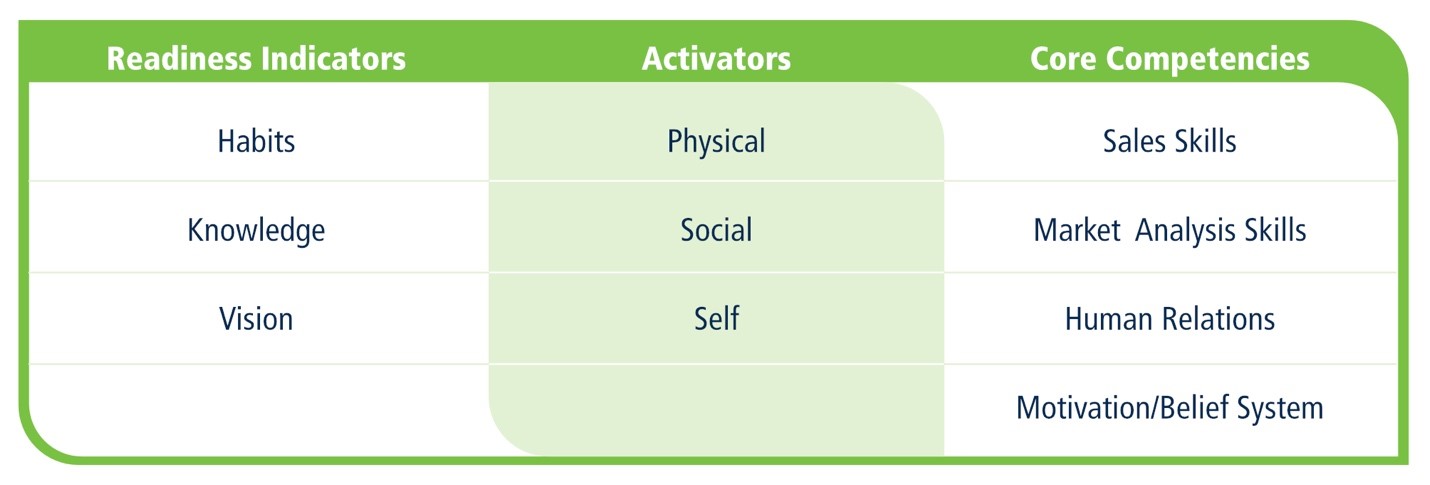
The Business Foundation is made up of:
- Readiness Indicators (Clients)
- Activators (Clients)
- Core Competencies (Realtor)
Readiness Indicators
As a realtor, you'll be working with clients who have varying needs and objectives. Probing for a prospect's Readiness Indicators will help you get to know the prospect and determine why they do what they do. Are they actually ready to buy and sell? The combination of a prospect's habits, knowledge, and vision will help you identify whether they'll be potential clients.
A prospect or client's Readiness Indicators include their:
- Habits
- Knowledge
- Vision
Here are some important Readiness Indicator descriptions.
Readiness Indicators (Prospect or Client)
Activators
Habits, knowledge and vision determine a prospect or client's decision-making behavior. It's your job to identify these, and then discover what will motivate them towards accepting and committing to an offer to sell or to commit to an offer to purchase - these motivating factors are called:
Activators.
Activators are a prospect or client's aspirations and motivations. The four prime Activators (similar to Abraham Maslow's Hierarchy of Needs) are:
- Physical
- Financial
- Social
- Self
Activators (Prospect or Client)
Core Competencies
In order to help clients achieve their goals, you must have or acquire the knowledge and skills (Core Competencies) to help them. Your success in building your business depends on your ability to develop and draw upon the following four Core Competencies:
The Business Process
The Business Process is about the day-to-day interactions with prospects and clients that will enable you to meet your sales goals and career objectives.